Sunday, April 20, 2025

Frogs Are Awake!

Image - Cable Natural History Museum

In another sign of spring, frogs and toads have started their raucous mating call season.  Over the past week of wetland hikes, their lovely sound has been in the air. 

True confession: I have a tin ear. So while I am hearing spring peepers, my hiking friends are also distinguishing wood frogs and boreal chorus frogs in that soundscape. I'm impressed by their skill - and also hopeful I can learn those calls better.

So far, I have been relying on last year's blog post with a short video of WI frog/toad callsWhen I'm on the trail, I just search for "frogs" and the post comes up. I listen to the video but it goes so quickly, I'm not sure I am identifying the frog/toad species correctly while I'm out in the wetlands or near ponds.

Naturalist Emily Stone of the Cable (WI) Natural History Museum to the rescue! On the Museum's website, there is a frog call identification post based on a program they developed for first grade field visits. Along with the short 22 second video of the calls (image posted above), each frog call has a luxurious 15-20 second clip alongside a picture and identifying details of the amphibian.

This will be my new go-to. As a former children's librarian, I always believed that any adult learner, working on a new skill, can benefit from looking at/reading (and listening to!) children's educational materials. 

So here goes!

Thursday, April 17, 2025

Leave No Trace Hiking - When Nature Calls

My mom always asked us kids before leaving the house for a car trip, "Did you check to the bathroom?' in the vain hope there would be fewer stops along the way.

Even as adults, no matter how we time things and even if we stop at a pit toilet at the trailhead, we often need a nature break along our hikes. There's a way to be more mindful about this to truly leave no trace on the trails.

Leaving traces
Image - Dana Hendricks

How many times have you seen little sodden piles of facial tissue along the trails? While those handy little packs of tissues are a convenient way to carry and take care of business while hiking, they are a lasting reminder of your nature break. Why?


An engineering friend of mine who worked at one of the big paper companies explained that those products are designed to be used more than once for things like tears and nose dabbing. They are specifically manufactured to be far sturdier and resistant to breakdown than toilet paper tissue. Hence the persistence of facial tissue along trail sides that seems to take forever (never?) to break down.

It's another reminder that when nature calls, we have responsibilities on the trails if we want to practice “leave no trace” hiking.

Here a couple of ideas to wean us from using facial tissues that litter the trail and woods. They aren't the only ones, but it will get you started.

Pack It Out
Bring a small plastic or wax paper bag and pack the used tissue out to dispose of at home. Positive: nothing left behind

Reusable Cloths
Use an old bandana, cut your own from tshirt rags or buy a Kula cloth - small reusable antimicrobial pee cloths that can snap on the outside of your backpack to dry and can be laundered. Positives: no waste.

Pee Funnels
Stand up and go - what's not to like? Carry these in a plastic bag or try this handy little origami-like number that unfolds and fits in your pocket in its own packet. Positives: no waste

Catholes
Pack a small kit with trowel and TP (take out the core) and hand sanitizer or purchase small kits that can help when you need to dig a cathole. Deposit solid waste in a cathole dug 6-8" down, and at least 200 feet from water, camp, and trails. Cover and disguise the cathole when finished. Bury toilet paper deep in a cathole or pack the toilet paper out along with hygiene products.

Pack Out Dog Doo
Really. Do It. Leave the trail better than you found it.

Being mindful of trail integrity and caring about other hikers who use the trails after us is a great way to leave no trace and preserve our beautiful outdoor resources.

Monday, April 14, 2025

Frequently Asked Blog Questions - Answered!

For those new to the blog or simply curious, here is a small tour of content, tips on using the different functions and a bit of history. Let me know if you have other questions and I’ll keep updating these FAQs (Frequently Asked Questions).

Commenting on Posts
I welcome comments. You'll be given a choice to "Comment as" followed by a black arrow. Click on that for a drop down menu -you have a choice to comment anonymously, with a Google account or with your name/url. It defaults to anonymous if you don't use the drop down menu. If you want to use your name, choose "name/url" option and type in your name. Just leave the the "url" box blank. Then type in your comment. I will see it and publish it. 

Subscribing
If you don’t use an RSS feed and want to make sure you receive each post as it is published, go to the subscribe box near the top  right and share your email. My subscription service is follow.it. You will automatically receive an email from Follow.it each time a post is published. 

Searching the Blog
If you want to search for something, it’s easiest to use the web version of the blog. If you are using a computer, you always see the web version and it’s easier to navigate.

You can use the search box near the top of the post which may bring waaaay more useless results than you’d like. Or you can take advantage of the “Labels,” or subject headings, I assign to each post (found on the right hand side of the post). Clicking on any of the labels will bring you to the relevant posts you are searching for.

Home Button
This is a handy little feature located on the bottom of each post. On your mobile phone, it displays a thumbnail list of posts with title, picture, date that you can quickly scroll through to find content you want to return to or read. Clicking on that small snapshot brings you to the post. On the web version, you see full post content. I love the mobile phone version best because it is so compact.

Using Mobile Phone vs Computer Web Version
Mobile phone works fine for reading the blog. However if you want to access some of the search and archival functions, the web version of the blog more easily gives you access to them. You can find a link to the web version on your phone at the bottom of each post,  It’s klunky to use on your phone though because the web version is so tiny. The computer web version gives you full size text and maneuverability in the page to access functions like the following:

Blog Archives
This is another fast way to quickly look through posts by date and then title in each month of a year. Click on the black arrow to the left of the year and it will display all the months of the year. Click the black arrow by any month and all blog titles for that month will appear. Click on any title to go to that blog post.

My Blog List
This is a list of hiking blogs or nature blogs that explore the natural world. I recommend all of them. Clicking on any title will bring you to that blog site.

Contact Form
If you want to get a hold of me, just fill in the form and I’ll get back to you via email.

Following the Blog
As far as I can tell, following the blog is more akin to liking a post on social media. You don’t receive posts as a follower but I can see you generally approve of it. Subscribing to the blog directly or through your feed is the only way to receive each post as it is published.

Columns/Regular Features:

  • Driftless Area Trail News - programs, advocacy opportunities, special events and other news of note for Driftless hikers
  • Trail Reviews/Descriptions - over 50 reviewed trails and many lists of recommended hikes by season, ability, and type (prairie, bluff, etc) - Use the label "find-a-hike" to search for hikes 
  • Gear Recommendations - based on seasons. Use the label "gear" to search for seasonal recommendations
  • Let's Get Hiking and Learning - monthly column listing of guided hikes, webinars, programs and opportunities for hikers around the Driftless region.
  • Naturalist's Corner - occasional column, often featuring guest naturalists digging deeper into an outdoor subject of interest to hikers. Got an idea for a a column? Reach out to me at lochwouters@gmail.com
  • I Spy on the Trails - monthly or bimonthly depending on season - a phenology listing of flora, fauna and weather observations from the trails during that month. Use the Label "I Spy on the Trails" to search for specific months.

History
Launched in April 2023, the blog came about because I wanted to combine my Master Naturalist volunteer training and learning with my background as a career librarian. There was so much I had learned from being part of hiking groups (Driftless Drifters, Jabberwalkers,  Blufflands Hiking group);  going on guided hikes offered through Driftless organizations and groups (federal refuge system, Mississippi Valley Conservancy, The Prairie Enthusiasts, the Friends of the Blufflands); and from following and learning from individuals online and IRL - I just HAD to share.

If you haven't already figured it out, there's nothing a librarian loves more than connecting people with information. I was also passionate about encouraging people to try new places and just get outside and explore all nature has to offer us, all year long.

I truly believe that no matter your age or ability you can always find a way to get into nature. Every hike doesn’t have to be bold and hard to be a fantastic hike. It can be flat, slow and gentle and still get you to small wonders and beautiful sights to fill your soul.

And so the blog was born. Here it is two years later - the blog has over 200 posts and 39,000+ views. I hope you share it with others who want to discover a new Driftless trail to hike and a way to be close to nature and tread lightly on the trails all year long.


Saturday, April 12, 2025

Volunteers for Nature Needed

Garlic mustard is overspreading many natural spaces. This tall, fast-growing, and huge seed-spreading plant outcompetes native plant species and quickly takes over areas. 

Early spring in the Midwest, when garlic mustard emerges -and before it sets seed - is the best time to go out and pull this invasive species. It’s pretty easy work. And it can yield some tasty tender leaves for garlic mustard pesto, a popular forager's delight!

If you see a call like the one below sponsored by my City of La Crescent, please consider pitching in as a volunteer for nature. It’s amazing how much we can beat back an invasive like this with a short hour of work together. 

And it’s a great way that we, as hikers, can contribute to the ongoing health and beauty of local natural areas we hike in. 

I'll be at this garlic mustard pulling project - and hope I can pull this invasive alongside you!


Thursday, April 10, 2025

Naturalist's Corner: Woodcocks - Dance Like No One's Watching

In this month's column, our guest is Janet Malotky, a bird watcher extraordinaire who was part of my 2022 Master Naturalist volunteer cohort. She is also a member of the Frontenac State Park Association. As an avid birder, she enjoys nothing more than getting outside, binoculars in hand, to revel in the amazing natural world around us. In this article, Janet looks at the antics and foibles of the woodcock in April. This article first appeared in the April 2025 edition of the Frontenac State Park Association newsletter,

Every April, a wacky bird glides into the forest edges of Frontenac State Park to once again bid for a mate and the continuation of the species –- long may they live! I’m talking about the American Woodcock, also known as the Timberdoodle, among other nicknames. They arrive from their wintering grounds in the southeastern United States and hit the ground … strutting? If you want to be delighted, click on this link to see the Woodcock taking a stroll.

The reason for this fancy walking style is not understood, though some wonder whether the rhythm drives their underground prey (worms, larvae, insects) to reveal themselves somehow. It doesn’t seem to be related to courtship rituals, as Woodcocks have acrobatic aerial displays for that purpose. But hey, it’s springtime, and maybe they’re just feeling jaunty.

Woodcocks are chubby grackle-sized birds with ridiculously long bills. They spend most of their time on the ground in areas of moist forest duff. We met their mudflat-dwelling cousins, the Wilson’s Snipes, in the October 2023 Bird Note. Like Snipes, Woodcocks probe deep into the soil with their sensitive, pliable bills to locate prey, which they slurp up while the bill is still underground. Their eyes are weirdly located high and toward the back of their head, giving them a wide field of vision, even when their bills are stuck deep into the soil. The female nests in a shallow depression on the forest floor, where she is exquisitely camouflaged.
American Woodcock on her nest near
Frontenac State Park’s Prairie Trail.
Image - Janet Malotky

Because of their excellent camouflage, Woodcocks are rarely seen in the wild. Your best chance to see one is during their aerial courtship displays. Almost every evening just after sunset, Woodcocks make their way from forest edge to open field/meadow/prairie. There the male begins to “peent.” He peents several times to let everyone know he’s there, and then he leaps into the air to begin his spiraling ascent high above the prairie floor. As he rises, the air rushing through his feathers makes a twittering sound (first part of recording). At the apex of his rise, he pauses, probably hoping a female is watching, before plummeting toward the ground in a freefall while chirping rapidly (last part of recording).

Is he chirping in terror? Just shy of impact, though, he resumes control and lands gently, often exactly where he took off, only to resume peenting. He then repeats the whole sequence again and again, continuing through the evening and sometimes through the night. Once courtship has been successful, the female makes a nest, lays and incubates the eggs, and feeds the young on her own. The male has put all his energy into flirtation.

I mentioned that we can experience this display in the park, and we can. However, as also mentioned, it happens after sunset. Our eyes are not our strongest asset in this setting. On a bright night, I have glimpsed only the silhouette of a Woodcock at different points during the display. But fortunately the entire sequence can be heard.

It’s pretty neat to go out on the prairie as twilight turns to dark and rely on just your hearing. A little spooky if the coyotes are also yipping. But remember, coyotes don’t eat people! They would love to eat a noisy Woodcock, though. Fortunately, Woodcocks can fly.


Monday, April 7, 2025

Whitewater Canyon Wildlife Area (IA) Lost Canyon Trail

I recently explored the Lost Canyon -Valley of 13 Caves Trail in the Whitewater Canyon Wildlife area on a hike sponsored by the She Explores Driftless Facebook hiking group. This Dubuque IA-based group was started by naturalists who wanted to hike for fun outside their jobs.  They share their passion for the outdoors and encourage women to build confidence in going out, exploring and creating friendships. 

This hike and group sounded right up my alley.  And who wouldn't want to hike through an area called the Lost Canyon and explore the Valley of 13 Caves?!? 

Dubuque and Jones Counties Conservation Boards cooperatively manage the Whitewater Canyon Wildlife Area. Over 500 acres are contained in the area with a number of designated trails. Hunting, hiking, angling, paddling and winter silent sports are all welcome in the wildlife area.

Our hike was described as: "2 miles on uneven hiking trails and hiking off trail on rocky & steep hillsides to access caves along the trail. Some caves are large enough to stand in, while some caves (for our adventure-seekers) require crawling. Wear sturdy shoes, a headlamp, and clothing that can get dirty." Sign me up!

Limestone cliffs
I arrived at the Whitewater Canyon Area trailhead near Dubuque in Bernard IA. There I met group of about 20 women from the greater Dubuque area (and some even further) who were raring to go on our cave-finding adventure.  

The 2.5 mile Lost Canyon trail (which includes the Valley of 13 Caves) follows a wide grassy path through a huge prairie area before it begins to descend into Lost Canyon. As soon as you start your descent, you see huge limestone rock formations on both sides of the now wooded hills. As we went further along the trail these formations towered over us and multiple caves could be seen up the steep hillsides. 

Small stalactites
Along the way, we were guided by naturalist Taylor Schaefers who shared plant identification, geology and history of the area in a conversational back-and-forth. Who knew that the Kentucky coffee trees we were seeing were initially planted by indigenous people near their dwellings and used for medicinal, recreational and spiritual practices. We do now! 

The hike itself was at a mellow pace and people could choose the level of challenge they were most comfortable with. I can only describe it as joyful. 


Cave bacon next to an explorer
heading into another chamber
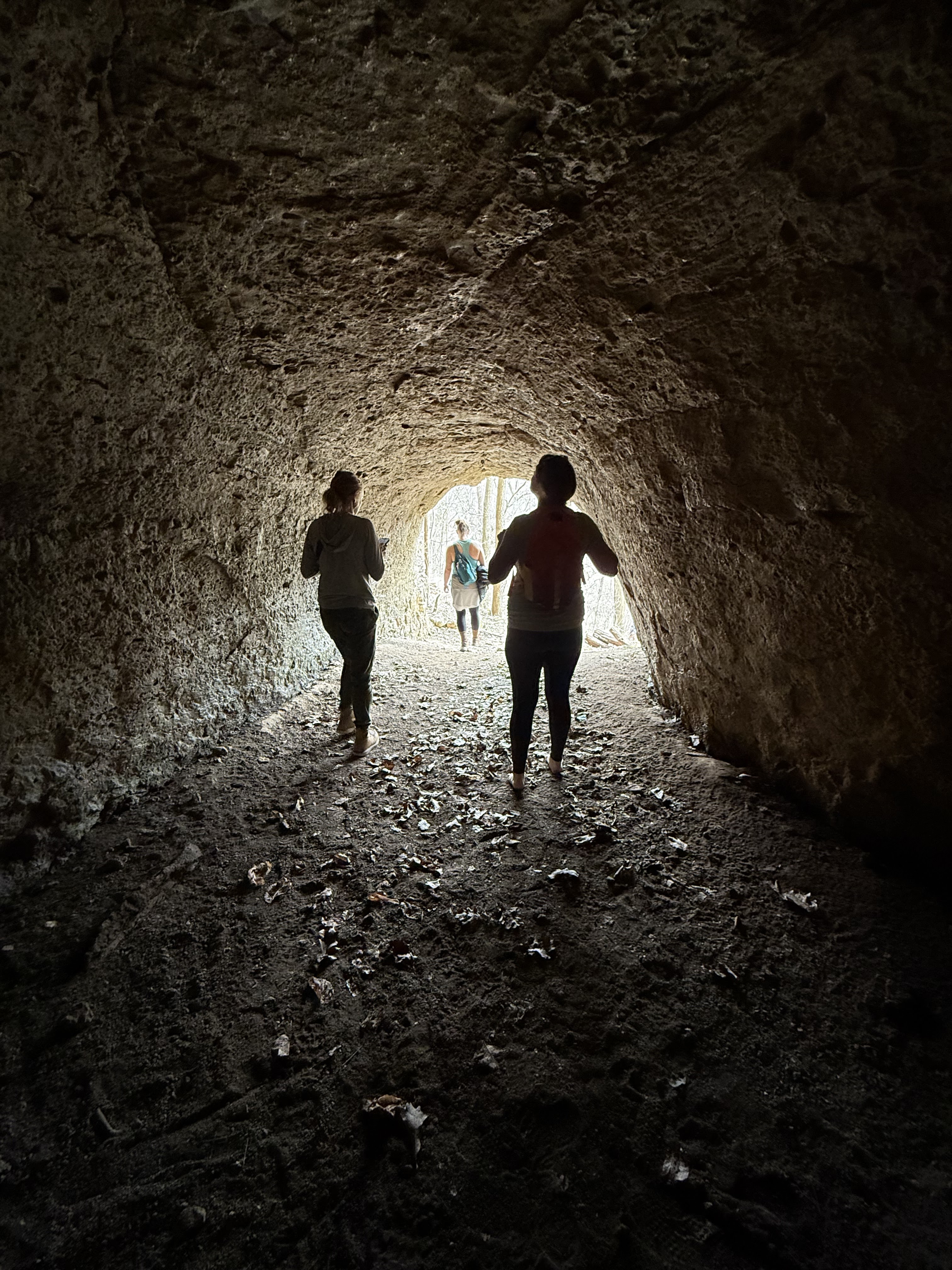
As to the caves, they were 100% worth the drive. While we didn't explore all 13 (and no doubt more) caves, we took time to explore five or six. Most of these were large enough to stand up in. Some featured large openings, others we squeezed under low openings before we stood up. For the more adventurous, often the caves had small openings on the sides or in back that revealed narrow chambers to crawl in and explore further.


Fossil in the cave wall


Some of the caves were dry, others featured continuous dripping water from the ceiling and walls that creates tiny, calcified stalagmites, stalactites and cave bacon. 

With our headlamps, we could also explore the walls and ceilings, looking for marine fossils embedded in the limestone. At one time, this area, like ours, was undersea. Limestone holds a rich fossil record of trilobites, shells, cephalopods and receptaculites.


Baby bloodroot
Because I was 100 miles south of my stomping grounds, I was delighted to see many early wild ephemerals that are nowhere near bloom -or sprout- time here in the La Crescent area. Spring beauties (their leaves are edible!); sharplobe and roundlobe hepatica; just about bloomed Dutchman’s Breeches; and a tiny delicate bloodroot made their appearance. 

Walking Fern

I spotted purple-margined liverwort and fern moss and was also introduced to a new-to-me fern: the walking fern. My eyes were bedazzled by this young growth after so many brown months.


After the hike at a nearby taproom, some of us gathered. Laughs, conversation and many ideas for hikes in the area were shared. Thanks Taylor, Andrea, Diana, Megan, Emily and others for all the ideas.


THE HIKE

From it's start on top the prairie, this grassy, 2.5 mile loop trail descends 250 feet into a wooded valley with huge limestone walls and tumbled rocks. On each side of the wide fairly flat trail, the steep hillsides climb towards multiple caves which are open to exploration. There are a few faint paths to follow up to them. A headlamp or flashlight reveals many calcified (and growing) formations like stalactites and stalagmites as well as embedded fossils in ceilings and walls. A last short, steep hill brings you out of the woods and back to a prairie with expansive views of the countryside and back to the trailhead. 

The Location    29912 9th Avenue, Bernard, IA 
25 miles southwest of Dubuque off Hwy 151, head south on Curoe Rd. Follow the park signage until you see a last sign indicating a right turn at the entrance. Follow the gravel road to the large parking lot. There is a pit toilet available. The Lost Canyon trail is marked and begins to the south of the parking lot kiosk.

She Explores Driftless hikers

Looking for more area hikes? Please stop by the web version of the blog and under the "Labels" tab on the right hand side of the blog, click on "find-a-hike". There are over 75 hike descriptions and lists of hikes to try!

Tuesday, April 1, 2025

I Spy on the Trails - March 2025

Lunar eclipse 3/14/25 taken
with iPhone 16 Pro Max
through a TeleVue 76 telescope


It's hard to settle on one highlight or observation this month as nature begins her spring wake-up in earnest (we hope!). Subtle and not so subtle signs abound.
  • The lovely surprise of a butterfly spreading its wings in the sun
  • The abundance of eagles on the ice edges and in flight, especially on a blufftop where they sweep past you at eye level
  • The return of some of the earliest fungi - scarlet elfin cups
  • The raucous calls of geese and trumpeter swans stopping briefly on the newly ice-free waters of the Mississippi River sloughs and La Crescent's Blue Lake to rest before racing on to their summer nesting grounds in the Arctic
  • Fuzzy buds

    The return of the robins and grackles in great flocks
  • Budding trees making the blufftops look fuzzy, a big change from the stark prickly look of winter treetops
  • The smoke plumes of prescribed burns on prairies promising lush growth of flowers and grasses in coming months


One of the warm days at Lytle's Landing
Image - Kris Lawson
The temperatures continued their fluctuations in March, flickering day by day between the 30s and 40's and then reaching into the 50s and 60s and even into the 70s before plunging back down. The winds were particularly notable - long-lasting and strong. March came in like a lion and pretty much stayed that way all month.

Weather stayed fairly dry throughout the month with three interesting exceptions. First, unexpected "mud rain" fell overnight on March 15. The phenomenon occurred when strong winds created massive dust storms in Texas and Oklahoma that sucked dust into the troposphere. Anything outdoors here was covered in dirt drops and car washes did land office business. That was followed a few days later by six inches of wet snow accompanied by thundersnow, sleet and hail. Luckily that melted in a few days to return us to sweet warm weather before a final long soaking rain came at the end of the month to green up the joint.

Plant Observations
  • Pasque flower
    My first Pasque flower of the season
    Holland Sand Prairie, March 25

  • Sprouts
    • Littleleaf buttercup
    • Meadow buttercup 
    • Motherwort 
    • Mullein clusters
    • Prairie violet 
    • White avens
    • Yarrow sprouts
  • Hexagonal-pored polyphore
  • Scarlet elfin cup

Whitewater Canyon Wildlife Area, Bernard IA
Ephemerals just emerging  (5/29)
  • Bloodroot
    Spring beauties 100 miles south!

  • Columbine
  • Dutchman’s breeches
  • False rue anemone
  • Fern moss
  • Purple-margined liverwort
  • Roundlobe hepatica
  • Sharplobe hepatica
  • Spring beauty
  • Walking fern


Wildlife Observations (seen, heard, detected)
  • Eastern Comma butterfly
    Eastern Comma

  • American eagle
  • Barred owl
  • Bluebird
  • Dark-eyed junco
  • House sparrow
  • Canada geese
  • Canvasback duck
  • Cedar waxwing
  • Downy woodpecker
  • Great blue heron
    Great blue heron

  • Killdeer
  • Mallard
  • Meadowlark
  • Northern cardinal
  • Northern flicker
  • Northern shrike
  • Pelican
  • Pileated woodpecker
  • Redwinged blackbird
    Nesting bluebirds
    Holland Sand Prairie

  • Rusty blackbird
  • Sandhill crane
  • Song sparrow
  • Tree swallow
  • Trumpeter swans
  • Wild turkey


What are YOU seeing on your hikes?

A month of hikes

Hikes below in colored, bold type or underlined have links to previous posts OR descriptions/location of the trails found online

ORA Community Farm trails, La Crosse WI; Eagles Bluff Park, La Crescent MN; Wagon Wheel Trail, La Crescent MN (2); City streets of Chicago , IL; Sugar Creek Bluff, Ferryville WI; Lytle’s Landing, Brice Prairie WI (2); Reno Quarry, Reno MN; Reno Spillway, Reno MN; Houska Park trail, La Crosse WI; Whitewater Canyon Wildlife Area, Bernard, IA, Holland Sand Prairie, Holmen WI (3); Trempealeau Wildlife Refuge, Trempealeau WI

When you hike with your yoga teacher,
you get a whole new view!
Reno Quarry rock formations
Image - Jean Hammons

The "I Spy on the Trails" column is a phenology (the study of seasonal changes in plants and animals) journal to chronicle year-round the weather, plant life and wildlife I observe while hiking. It is very useful in helping me compare observations from year-to-year. The column is published monthly from September through April and then twice-a-month from May through August when warm weather brings the natural world back to vibrant life.  

Images, unless noted - Marge Loch-Wouters