Showing posts with label wildflowers. Show all posts

Sunday, August 16, 2026

I Spy on the Trails - August 1-15, 2026

Twin Springs Trail, Decorah IA

I spent a quieter two weeks waiting for a steroid shot to kick in on the bum foot. Shorter, slower and flatter hikes were my jam. While going slow didn't get me far, it gave me lots of time to linger and observe dragon- and damselflies, bumblebees, butterflies and oh so many flowers and fungi!

Our mornings are already starting to be dewy and foggy and we received a bit of rain throughout these two weeks. Temperatures were a seasonal high 70s and 80s. Humidity was variable. My goal was getting out early before the heat piled on, so mosquitoes and I made some acquaintance on the trails!


Pre-emergent dog-day cicada nymph
Note the split starting at the head
 

The most fun day of hiking  brought a friend and me to three spots in Decorah IA: Butterfly Garden and Community Prairie; Twin Springs Park and Malanaphy Springs. We clocked in with 4 miles on flat and some rolling trails over the course of the morning and early afternoon. It was great to stretch out a bit more to test my foot and we saw amazing sights at each trail.  Seeing a pre-emergent dog-day cicada nymph casing (note the split in the back where the adult emerges) was the best!


On the learning front, I give a huge shout-out to the Friends of Houston (MN) Nature Center.  They sponsorsed an outstanding talk by Dan Jackson about the characteristics and life cycle of dragon- and damselflies. I learned a ton. They also developed a great informational display at the center on these fascinating members of the odonata order.

Hope you can take advantage of the many learning opportunities like this in the Driftless. They'll enrich your time on the trails!

Can you spot the common green darner dragonfly?

Plant Observations
Bloomed:

  • alyssum, hoary
    Spotted bee balm with
     brown-belted bumblebee

  • beebalm, spotted
  • bellflower, American
  • black-eyed Susan
  • blazing star, dwarf (or cylindrical)
  • blazing star, meadow
  • blazing star, prairie
  • Blazing star, rough
  • boneset, false
  • boneset, tall
  • buttercup, water
  • catnip
  • cinquefoil, tall
  • clover, purple prairie
  • clover, silky prairie
  • clover, white prairie
  • compassplant
  • coneflower, cutleaf
  • coneflower, grey-headed 
    Compassplant

  • coneflower, sweet
  • coreopsis, prairie
  • cupplant
  • Culver’s root
  • fern, bracken
  • fern, bulblet bladderfern
  • fern, interrupted 
  • fern, lady
  • fern, New York
  • fern, northern maidenhair
  • flax, grooved
  • fleabane, prairie
  • germander, American
  • goldenrod, Canada
  • goldenrod, early
    Joe-Pye weed

  • goldenrog, giant
  • goldenrod, gray
  • goldenrod, Missouri
  • goldenrod, tall
  • goldenrod, white flat-topped
  • harebell
  • indigo, wild white
  • ironweed, prairie
  • jewelweed
  • Joe-Pye weed, sweet
  • leafcup, small-flowered
  • milkweed, butterfly weed
  • milkweed, common
  • milkweed, whorled
  • mint, slender mountain
    Plains snakecotton
    (a first for me!)

  • mint, Virginia mountain 
  • onion, nodding
  • partridge pea
  • poppy mallow, purple
  • primrose, evening
  • snakecotton, plains
  • snakeroot, white
  • spurge, flowering
  • sunflower, false
  • sunflower, few-leaf
  • sunflower, stiff
  • sunflower, western (few-leaf)
  • primrose, evening
  • rattlesnake master
  • vervain, blue
  • wild bergamot
  • wild quinine

Grasses/sedges:
  • grass, big and little bluestem
    Purple lovegrass and
    little blueste
  • grass, bottlebrush
  • grass, Canada wild rye
  • grass, purple lovegrass
  •  grass, side oats grama
  • grass, switchgrass
  • grass, Virginia wild rye
  • grass, yellow indiangrass
  • sedge, white bear


Greened/sprouted:

  • artichoke, Jerusalem
  • aster, white heath
    Field thistle, 
    a native forb
  • bushclover, roundheaded
  • blazing star, rough
  • goldenrod, showy
  • goldenrod, stiff
  • sagebrush, white
  • sunflower, stiff
  • thistle, field

Fruited/Past bloom:

  • coreopsis, prairie
  • leadplant
  • St. John’s wort


Green cheese polypore mushroom
Moss/Lichen/Fungi
  • fungi, white jelly
  • fungi, wolf’s milk slime mold
  • moss, woodsy thymemoss
  • mushroom, artist’s conk 
  • mushroom, fuzzy foot
  • mushroom, golden oyster
  • mushroom, green cheese polypore
  • mushroom, hexagonal polypore
  • mushroom, russula, blood red
  • mushroom, russula, pocket-stalked 
  • mushroom, scarlet elfin cup
  • mushroom, slippery Jack
  • mushroom, sweetbread

Wildlife (seen, heard, detected):
Birds

  • blue jay
  • bluebird, eastern
  • cardinal
  • catbird, grey
  • cedar waxwing
  • chickadee, black-capped
  • dickcissel
  • finch, house
  • finch, purple 
  • flycatcher, least
  • gnatcatcher, bluegray
    Bell's vireo
    Image - Jonathan Irons
    Merlin Bird ID

  • goldfinch, American
  • goose, Canada
  • hawk, red-tailed
  • indigo bunting
  • killdeer
  • kingbird, eastern
  • mourning dove
  • sparrow, clay-colored
  • sparrow, field
  • sparrow, house
  • sparrow, savannah
  • sparrow, song
  • sparrow, swamp
  • vireo, Bell's
  • vulture
  • warbler, northern yellow
  • wood-pewee, eastern
  • woodpecker, downy
  • woodpecker, hairy
  • wren, northern house
  • wren, sedge
  • yellow throat, common


Insects:

  • beetle, goldenrod soldier
  • bumblebee, black-and-gold
  • bumblebee, brown-belted
  • bumblebee, common eastern
  • bumblebee, lemon cuckoo
  • butterfly, eastern tailed-blue
    Eastern tailed-blue butterfly 
    (another first for me!)

  • butterfly, Monarch
  • butterfly, northern crescent
  • butterfly, painted lady
  • butterfly, red admiral
  • butterfly, silver-spotted skimmer
  • butterfly, swallowtail, black
  • butterfly, swallowtail, tiger
  • cicada, dog-day nymph
  • damselfly, tule bluet
  • damselfly, white-legged
  • dragonfly, autumn  meadowhawk
  • dragonfly, eastern amberwing
  • dragonfly, eastern pondhawk
  • dragonfly, green darner
  • dragonfly, twelve spotted skimmer
  • dragonfly, widow skimmer 
  • grasshopper, red-legged
  • wasp, great black digger

What are YOU seeing on your hikes?

Two weeks of hikes
Hikes below in colored, bold type or underlined have links to previous posts OR descriptions and/or location of the trails found online.

Holland Sand Prairie, Holman WI (2); Twin Springs, Decorah IA; Butterfly Garden and Community Prairie, Decorah IA; Malanaphy Springs, Decorah IA;  Upper Mississippi National Wildlife & Fish Refuge Visitor's Center, Brice Prairie; Great River Bluffs State Park, Nodine MN

See you on the trails!

Rock formation
Malanaohy Springs trail, Decorah IA


The "I Spy on the Trails" column is a phenology (the study of seasonal changes in plants and animals) journal to chronicle year-round the weather, plant life and wildlife I observe while hiking. It is very useful in helping me compare observations from year-to-year. The column is published monthly from September through April and then twice-a-month from May through August when warm weather brings the natural world back to vibrant life.


Images, unless noted - Marge Loch-Wouters


Primo prairie time, mosquito-free!


You can read my quarterly column on seasonal hiking suggestions in Inspire(d) Driftless magazine available online or pick up a free copy at businesses and organizations around the Driftless areas of Minnesota, Wisconsin and Iowa.

Thursday, December 5, 2024

Naturalist's Corner - Winter’s Hidden Ecosystems

I recently started following another hiking and nature enthusiast, Gary Kurtz, on Facebook. He posts at Wildflowers Wisconsin. He is a  lyrical writer who opens up the world of nature to readers with keen insights and deep knowledge. His Facebook posts are perfect tidbits of information on flora, fauna, fungi and observations on what we can observe and understand  in nature. Gary also has an Etsy shop where he sells his ebooks of seasonal wildflowers. You can download them to your device and use them as you are walking in spring and summer to help with field identification. Gary graciously agreed to be our guest columnist this month and shared this Facebook post with us from November 28, 2024.  


Winter, a season of profound stillness, casts a serene yet formidable spell over the landscape. In this time of frost and scarcity, both plants and animals reveal their remarkable strategies for survival. 

Many plants retreat into dormancy. Deciduous trees—oaks, maples, and birches—surrender their leaves to conserve precious water and shield themselves from the weight of snow and ice. Their skeletal branches etch stark silhouettes against the winter sky.  In contrast, the evergreens—pines, spruces, and firs—retain their needles. These needles, cloaked in a protective wax, guard against desiccation and the biting cold. Their deep green hue allows for a small amount photosynthesis even in the heart of winter.

Beneath the snow, the forest floor holds a different kind of life. Perennial plants and bulbs lie dormant, insulated by the snow, which acts as a blanket, protecting them from the extreme cold. This layer of snow also traps heat from the ground, preventing frost from penetrating too deeply and damaging the roots.

Animals exhibit a range of behaviors and physiological changes to cope with winter. Squirrels and chipmunks busily gather and store nuts and seeds, creating caches that will sustain them when food is scarce. Birds like sandhill cranes and Canada geese skip out on long migrations to warmer climates, while monarch butterflies undertake an incredible journey to Mexico. Black bears retreat into hibernation, their metabolic rates dropping as they live off stored fat, and groundhogs enter deep hibernation, their body temperatures plummeting to conserve energy. Bats find shelter in caves, slowing their metabolism to survive on minimal energy. Coyotes, ever adaptable, remain active, hunting and scavenging with their thick fur providing insulation. White-tailed deer grow thicker coats and seek shelter in dense forests, reducing their activity to conserve energy. Remarkably, wood frogs produce a natural antifreeze, allowing them to survive being frozen.

Social behaviors also play a crucial role in winter survival. Birds like chickadees and titmice huddle together for warmth, while others roost in tree cavities. Badgers dig extensive networks of burrows, entering a state of torpor to conserve energy, while turtles and frogs burrow into mud and sand to hibernate. Even the elusive snowshoe hare changes its fur color to white, blending into the snowy landscape for camouflage. These strategies showcase the incredible adaptability of Wisconsin’s wildlife, ensuring their survival through the harsh winter.

Snow plays a crucial role in the winter ecosystem. As it accumulates, it provides insulation for plants and small animals, creating subnivean spaces (the area between the ground and the bottom of the snowpack) where creatures like mice and voles can move about safely, protected from predators and harsh weather. These small mammals remain active, foraging for seeds and roots, which helps maintain the food web.

Aquatic life also adapts to the winter conditions. Ponds and lakes may freeze over, but below the ice, water temperatures remain relatively stable. Fish, such as trout and bass, enter a state of reduced activity, slowing their metabolism to conserve energy. Some amphibians and reptiles, like frogs and turtles, burrow into the mud at the bottom of ponds, where they remain dormant until the spring thaw.

Winter is a harsh season requiring adaptation. Plants and animals employ a variety of strategies to survive the cold, and these adaptations highlight the intricate and dynamic nature of ecosystems. The stillness of winter belies the subtle and continuous interactions that sustain life, setting the stage for the renewal and growth that come with the arrival of spring.

Images - Marge Loch-Wouters


Sunday, September 1, 2024

I Spy on the Trails - August 16-31, 2024


Well into August, the lush summer prairie flora are finishing their prime season and many former spectacular blooms are quietly setting seed. Grasses are starting to dominate prairie landscapes as we head towards fall. The cool nights signal the blazing stars and asters to begin their show - and what a show the blazing stars have been putting on! Monarch butterflies have been prolific in these flowers.

The weather was mostly dry 80s and pleasant with only a few days of high humidity 90s near the end. A final set of strong storms dumping inches of rain in just a few hours ushered in cooler weather for the holiday weekend. Whew.

MN Master Naturalist class
Image - Sara Holger

During the past two weeks, it was fun to do a presentation to a MN Master Naturalist class out of Winona on post-certification volunteer work and lead them on an interpretive hike. It was great to see so many new faces and to re-connect with their instructor, Sara Holger. I hope if you have the opportunity, you consider this certification in your area.


Monarch on blazing star


Now that we are hitting cooler and less buggy weather, I’ll be hiking back up to bluff tops to get bird's eye views of changing forest colors and wider vistas as foliage dies back. It's also a great time to start hiking some less-traveled trails that are very brushy in summer. They are lots easier - though burr-filled - in fall as the foliage dies back.


As we get to September, it's good to start taking precautions on trails as fall hunting seasons kick in. I shared some tips on this recently along with 2024 hunting season information for MN, WI and IA.

I will be going back to monthly “I Spy” phenology posts in September through the winter. I’ll also be off on some much anticipated fall adventures - canoeing up in Canada’s Quetico Provincial Park wilderness followed by a trip out west to explore trails in Utah and Colorado. 

See you on the trails!

Plant Life
  • Bee balm
    Stiff goldenrod

  • Woodland sunflower
  • Ghost pipes
  • White snakeroot
  • Turkey tail shelf mushrooms
  • Spotted bee balm
  • Poppy mallow
  • Bergamot
  • Hoary verbena
  • Partridge pea
  • Swamp milkweed
  • Common milkweed
  • Whorled milkweed
  • False sunflower
  • Few-leaf sunflower
  • Stiff sunflower
  • Black-eyed Susan
  • Brown-eyed Susan
  • Cup plant
  • Compass plant
  • Sensitive fern
  • Marsh fern
  • Lady fern
  • Eggs-and-butter (yellow toadflax)
  • American wild mint
  • White sagebrush
  • Purple prairie clover
  • American white water lily
  • Common evening primrose
    Wild perennial lupine

  • Common prickly ash
  • Wild perennial lupine
  • Guelder-rose bush
  • Gray dogwood
  • Arrowhead viburnum
  • Great blue lobelia
  • Tall thimbleweed, past bloom
  • Roundleaf bittersweet
  • Canada goldenrod
  • Stiff goldenrod
  • Showy goldenrod
  • Gray goldenrod
  • Purple loosestrife
  • Swamp loosestrife
  • Flowering spurge
  • Leafy spurge
  • White meadowsweet
  • Tall boneset
  • Water smartweed
    White heath aster

  • Giant chickweed
  • Prairie ironweed
  • American wild mint
  • Mullein
  • Western silver aster
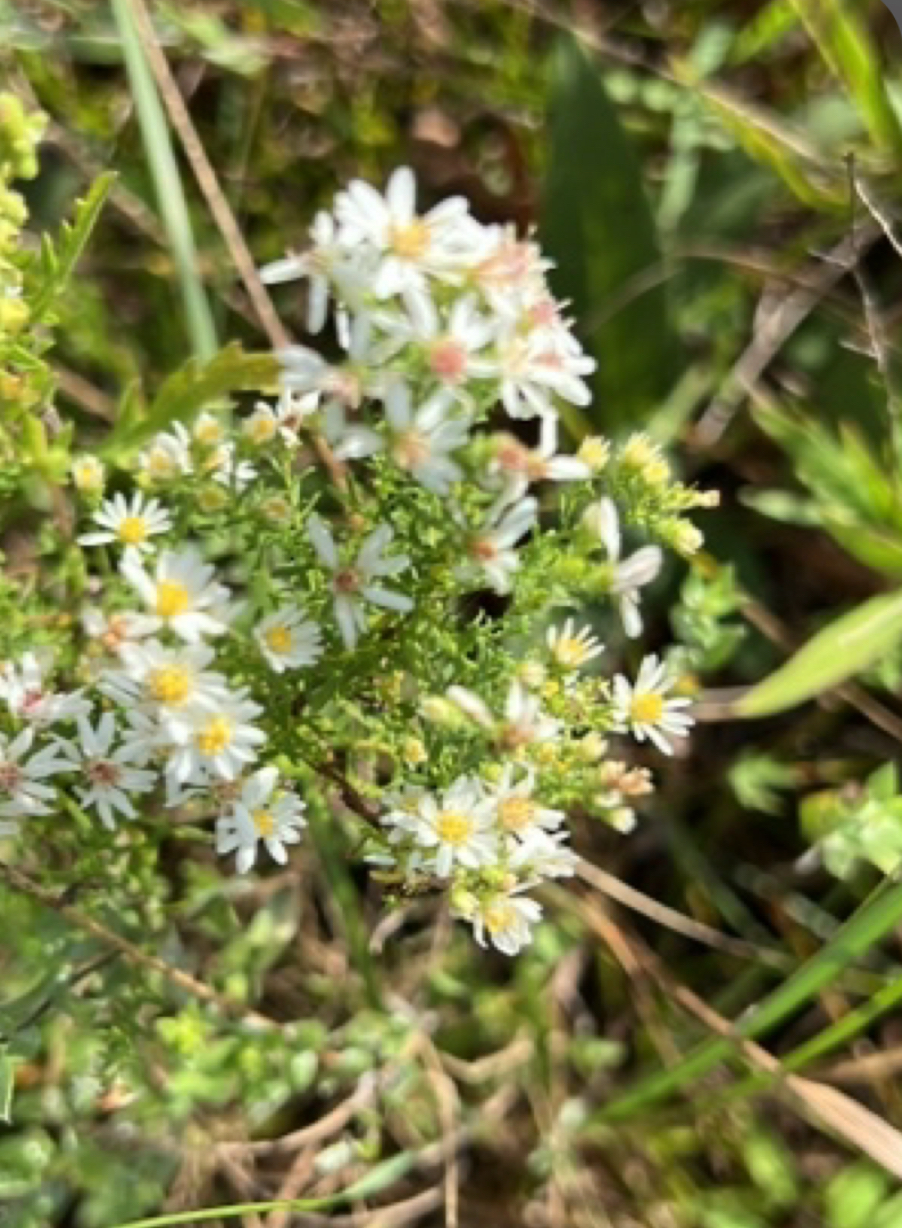
  • White heath aster
  • Calico aster, pre-bloom
  • Hairy aster, pre-bloom
  • Jewelweed
  • Leadplant 
  • Wild rye grass
  • Big bluestem grass
  • Yellow Indiangrass
  • Prairie cordgrass
  • Spiderwort,
  • Sagebrush lavender
  • Grooved flax
  • Prairie rose hips
  • Roundleaf bushclover

Wildlife (seen, heard, detected)
  • American Eagle
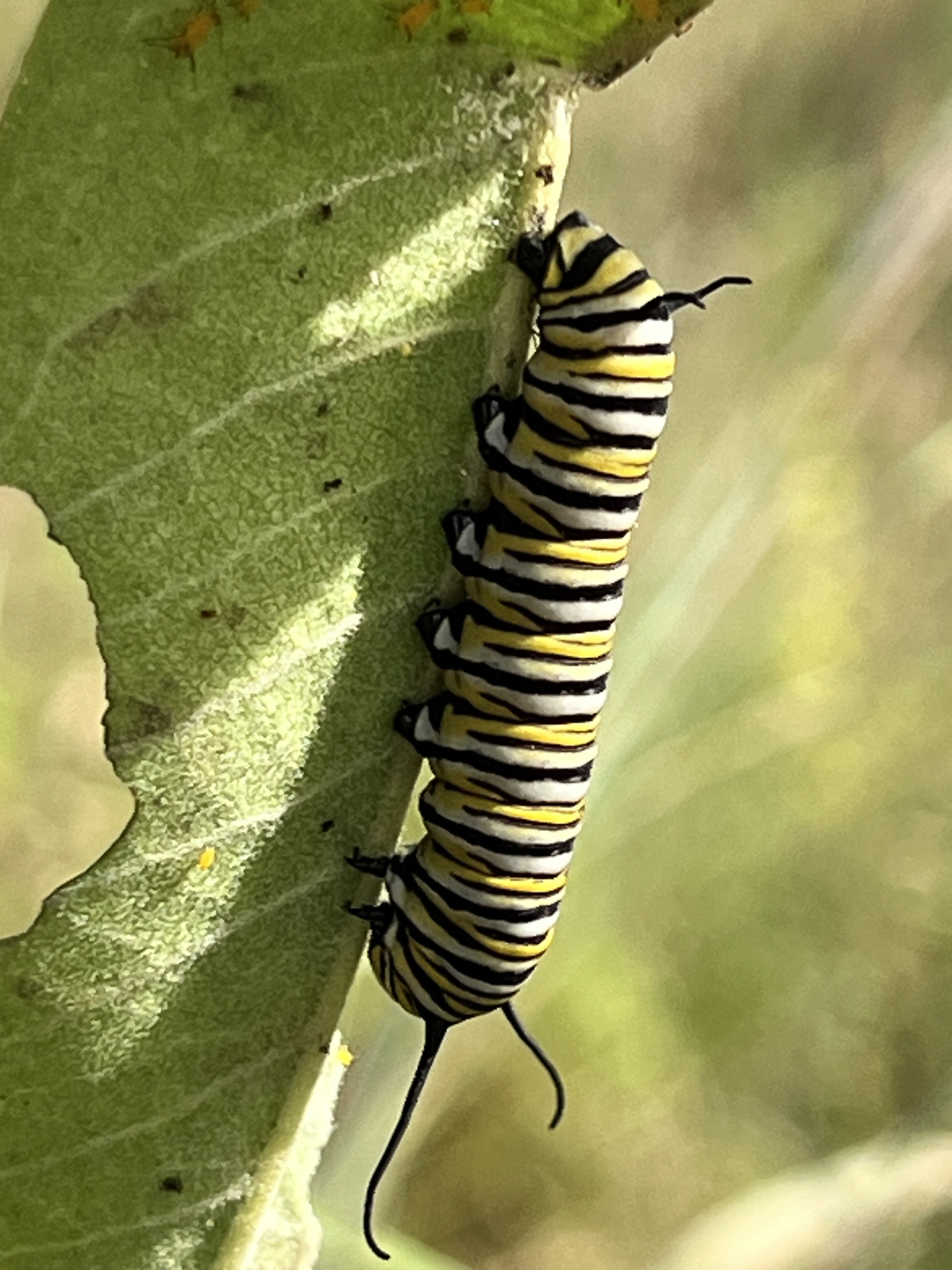
    Monarch butterfly caterpillar
  • Sandhill cranes
  • Pileated woodpecker
  • Downy woodpecker
  • Hairy woodpecker
  • Red-bellied woodpecker
  • American crow
  • Blue Jay
  • Black-capped chickadee
  • American pelican
  • Eastern wood-pewee
  • American goldfinch
  • Canada warbler
  • Indigo bunting
  • Barn swallow
  • Field sparrow
  • Northern cardinal
    Milkweed bug

  • House finch
  • House wren
  • Baltimore oriole
  • Grey catbird
  • White-breasted nuthatch
  • Monarch butterfly
  • Swallowtail butterfly
  • Clouded yellow butterfly
  • Pearl crescent butterfly
  • Milkweed bug
  • Monarch butterfly caterpillar 
  • Milkweed tussock moth caterpillar 
  • Leopard frog

What are YOU noticing on your hikes?

Two weeks of hikes:
Hikes below in bold color or underlined have links to previous posts with descriptions/location of the trails
Upper Hixon Forest Prairies trail, La Crosse WI; Mt. Hosmer, Lansing IA; Trempealeau National Wildlife Refuge, Trempealeau WI(2); Upper Mississippi National  Fish and Wildlife Visitor's Center, Brice Prairie WI; Holland Sand Prairie, Holmen WI (2) 

In a sea of rough blazing stars - Holland Sand Prairie
Image -Lloyd Lorenz

The "I Spy on the Trails" column is a phenology (the study of seasonal changes in plants and animals) journal to chronicle year-round the weather, plant life and wildlife I observe while hiking. It is very useful in helping me compare observations from year-to-year. The column is published monthly from September through April and then twice-a-month from May through August when warm weather brings the natural world back to vibrant life.

Images, unless noted - Marge Loch-Wouters

Thursday, May 16, 2024

I Spy on the Trails - May 1-15, 2024

Bishop's cap

Whoa, back to bimonthly phenology observations! So many blooms and bird calls, frog choruses and budding trees in just two weeks. My phenology lists exploded! The warm weather and frequent rain have brought a vibrancy and proliferation of wild things that was muted in the last droughty year. 

The warbler migration has begun in earnest. Every day brought more and different species to my ears and eyes.

Bristly buttercup

Ephemerals are busting out in woodland and wetland walks. Again, every hike brought new wildflower delights popping up. Some are like old friends; others so rare I have to check my identifications to see if I have them right.

I took advantage of some guided hikes during these two weeks. Our surprise guide on Trempealeau Wildlife Refuge’s World Migratory Bird Day birding hike was Stan Tekiela, naturalist and author of many guidebooks to birds around the country. 

Mayapple

I also participated in  BOW (Becoming An Outdoor Woman) hike learning about and then hunting morel mushrooms (success!). Heading into the Drifted area around central WI, friends and I hiked the sand country and eskers of the terminal glacial moraine at Mecan Springs. All those hikes were packed full of interesting details and learning. 


Wetland warbler habitat

I hope you to take advantage of these kinds of guided hikes. They are led by passionate and knowledgeable naturalists who love the land and all it holds. 

And you will hone your own natural naturalist skills!


Plant Life

  • False rue anemone
  • Trout lily
  • Bellwort
  • Ramps
  • Dryad's saddle
  • Morel mushrooms
  • Virginia bluebells
  • Jacob’s ladder
  • Two leaf miterwort (Bishop’s cap)
  • Cutleaf toothhwort
  • Dutchman’s breeches
  • Canadian ginger
  • Bloodroot
  • Littleleaf buttercup
  • Bristly buttercup
  • Spring beauty
  • Wintercress
  • Early meadow rue
  • Sharplobe hepatica
  • Wild geranium
  • Pussytoes
  • Wood anemone
    Virginia bluebells

  • Bladder fern
  • Maidenhair fern
  • Rattlesnake fern
  • Lady fern
  • Bulblet fern
  • Lowland blader fern
  • Sharp-lobed hepatica
  • Mugwort
  • Rattlesnake plantain
  • Fan clubmoss
  • Bracken
  • Pennsylvania sedge
  • Prairie blue-eyed grass
  • Starry false Solomon’s seal
  • Hoary puccoon
  • Jack-in-the-pulpit
  • Downy yellow violet
  • Violet woodsorrel
  • White rattlesnakeroot (unbloomed)
  • Dryad’s saddle
  • Trillium
  •  Nodding wakerobin trillium
  • Sweet cecily


Wildlife (seen, heard, detected)

  • Osprey
    Can you spot the eagle on kin's* nest?

  • Eagle
  • Yellow warbler
  • Nashville warbler
  • Blue-winged warbler 
  • Yellow-rumped warbler
  • Chestnut-sided warbler
  • Prothonotary warbler
  • Tennessee warbler
  • Palm warbler
  • Blackpoll warbler
  • Blue-winged warbler
  • Cape May warbler
  • Blackburnian warbler
  • Bay-breasted warbler
  • Magnolia warbler
  • Wilson’s warbler
  • Northern Parula
  • Common yellowthroat
  • American redstart
  • Scarlet tanager
  • Summer tanager
  • Indigo bunting
  • Tufted titmouse
  • Field sparrow
  • Song sparrow
  • White-throated sparrow
  • Swamp sparrow
  • Rose-breasted grosbeak
  • Red-winged blackbird
  • Eastern kingbird
  • Eastern bluebird
  • Goldfinch
  • Blue-gray gnatcatcher
  • Downy woodpecker
  • Red-bellied woodpecker
  • Hairy woodpecker
  • Pileated woodpecker
  • Yellow-bellied sapsucker
  • Eastern phoebe
  • Northern flicker
  • Tree swallow
  • Brown thrasher
  • Northern waterthrush
  • Louisiana waterthrush
  • American redstart
  • Baltimore oriole
  • Orchard oriole 
  • Ovenbird
  • Chimney swift
  • Brown-headed cowbird
  • Yellow-throated vireo
  • Warbling vireo
  • Red-eyed vireo
  • Black -capped chickadee
  • Eastern towhee
  • Northern mockingbird
  • American eagle
  • Sandhill crane
  • Blue heron
  • Bluejay
  • Wood thrush
  • Yellow-bellied flycatcher
  • Great crested flycatcher
  • Red cardinal butterfly
    Meadow Fritillary

  • Monarch butterfly
  • Meadow Fritillary
  • Swallowtail butterfly
  • Spring peepers
  • Chorus frog
  • Wood fog
  • Garter snake
  • Painted turtle


What are YOU noticing on your hikes?

Two weeks of hikes:


On the hunt (successfully) for warblers
Image - Lloyd Lorenz


*Robin Wall Kimmerer, author of Braiding Sweetgrass (among many books) and enrolled member of the Citizen Potawatomi Nation, suggested in a recent talk that rather than referring to plants, wildlife and other beings found in nature as "it", we use a work like "kin." The word gives agency to the life all around us in nature. It resonates with me.

.The "I Spy on the Trails" column is a phenology (the study of seasonal changes in plants and animals) journal to chronicle year-round the weather, plant life and wildlife I observe while hiking. It is very useful in helping me compare observations from year-to-year. The column is published monthly from September through April and then twice-a-month from May through August when warm weather brings the natural world back to vibrant life.   

Images, unless noted - Marge Loch-Wouters

Monday, April 15, 2024

I Spy on the Trails - April 2024

Holy moly, spring is busting out early. We had some fine snow and rain at the beginning of the month followed by warm temps and the wildflowers went, well...wild! 

It also helped that I went south 50 miles into Iowa to hike at the Yellow River State Forest a few times. We saw alot of great wildflowers that aren't quite up yet around here. And the trees were starting to leaf out there which is very early.

Bird migration is in full swing. The waterfowl have mostly migrated through but the songbirds are definitely returning in large numbers,. Adding to the chorus over the past two weeks are Eastern towhee, brown creeper, red-winged blackbird, rusty blackbird, brown-headed cowbird, eastern meadowlark, golden-crowned kinglet, northern flicker and more. Warblers are just starting their migration, although with trees beginning to leaf out, it will be a challenge to spot them.

And speaking of choruses, wood frogs and spring peepers are much in evidence.

It's a fine time to enjoy the spring woods!

Plant life

Dutchman's breeches. Canadian wild ginger,
Bloodroot, scarlet cup

  • Shining clubmoss
  • Lyreleaf rock cress
  • Ramps
  • Red stemmed feather moss
  • Hepatica
  • Dutchman's breeches
  • Canadian wild ginger
  • Bloodroot
  • Cutleaf toothwort
  • Long talk sedge
  • Scarlet cup
  • Rockcap fern
  • Walking fern
  • Bladder fern
  • Sharplobe hepatica
  • Roundlobe hepatica
  • False rue anemone
  • Rue anemone
  • Liverwort
  • Bristly buttercup
  • Birdsfoot violet
  • Common violet
  • Bastard toadflax (unbloomed)
  • Trout lily (unbloomed)
  • Puddy root orchid
  • Wild strawberry
  • Spring beauty
  • Prickly pear (!) - blufftop, dry prairie
  • Virginia waterleaf
  • Mayapple
  • Hoary puccoon
  • Pussytoes
  • Sweet cecily
  • Bellwort
  • Shotting star
Hoary puccoon


Wildlife (seen, heard, detected)

  • Red cardinal butterfly
  • Red cardinal butterfly 
    nectaring on Dutchman's Breeches


    Mourning cloak butterfly
  • Trumpeter swans
  • Tundra swans
  • Wood frogs
  • Spring peepers
  • Snapping turtle
  • Dragonflies
  • Pileated woodpecker
  • Red headed woodpecker
  • Downy woodpecker
  • Red-bellied woodpecker
  • Hairy woodpecker
  • Yellow-bellied sapsucker
  • Eastern towhee
  • Tufted titmouse
  • Song sparrow
  • American tree sparrow
  • Golden-crowned kinglet

  • Painted Turtle
  • Ruby-crowned kinglet
  • Chipping sparrow
  • Rusty blackbird
  • Red-winged blackbird
  • Goldfinch
  • Black-capped chickadee
  • White-breasted nuthatch 
  • Northern cardinal
  • Northern flicker
  • Great blue heron
  • Sandhill cranes
  • Blue jay
  • Turkey vultures
  • Brown creeper
  • Brown-headed cowbird
  • Barred owl
  • Wood duck
  • Blue-winged teal
  • Green-winged teal
  • Robin
  • Widgeon
  • Coots
  • Pelicans
  • Killdeer

What are YOU noticing on your hikes?

Month of hikes:
Whitewater WMA, Nursery Trail, Altura MN; Mississippi/Big Bear/Mud Hen Trail, Painted Rock Unit, Yellow River State Forest, Harper’s Ferry, IA (2); Beaver Creek Valley State Park, Caledonia MN; Lytle’s Landing, Brice Prairie WI (2); Greens Coulee/Savannah Oaks, Onalaska WI; La Crosse River Marsh Trails, La Crosse WI

On the rocks at Yellow River State Forest, IA
Image -Kris Lawson

The "I Spy on the Trails" column is a phenology (the study of seasonal changes in plants and animals) journal to chronicle year-round the weather, plant life and wildlife I observe while hiking. It is very useful in helping me compare observations from year-to-year. The column is published monthly from September through April and then twice-a-month from May through August when warm weather brings the natural world back to vibrant life.  

Images (unless noted) - Marge Loch-Wouters

Sunday, October 15, 2023

I Spy on the Trails - Oct 1-15, 2023

It’s been a long and languorous fall. We received some rain over the past two weeks (and a lot going into this weekend) which got the lawns around town pretty excited. Temperatures finally began to hit our more usual 50s-60s F and a first nip of frost here and there brought us briefly into the mid-30s. A precipitous 2 week drop! While some mourn the cooler days, I welcome the crisper temps I hope are coming. With September on record as one of the hottest months world-wide, we are seeing real-time results of accelerating climate change.

I spent some time up on the North Shore on MN this past week and was treated to some new plants and fungi. It was really pleasant driving back and forth and seeing the colors change as we headed north than back south on the 350 mile trip. 

I came across a lovely blog post from the Friends of the Blufflands this week. Written by Jon Rigden, it talks about this time of year and the profusion of asters along the trails. Each flower gets it's special time and, for asters, its now.

Also profuse this year are the acorns!  From the Driftless up through MN’s northwoods, we have been crunching over oodles of acorns on our hardwood forest trail hikes. The oaks are having a “mast” year where an oak might produce up to 10.000 acorns rather than the more usual 2000. Mast years occur in an irregular cycle about every 5 years. During mast years, the oaks slow their growth and put all their energy into seed production. What is particularly curious is that oaks across wide regions seem to synchronize their mast seeding. While people often attribute this to a coming colder winter or drought year, scientists are still studying exactly why and how this is happening. For now, let’s just say it’s a wonder of nature.

The vegetation continues to die back along the trails and the birds are more silent. Warblers appear to be flitting quickly through. We are still waiting for the bulk of the geese and swan migrations that peaks in late October and through November. 

Colors in the Driftless are just starting to peak but the frost may turbo-charge the color. Be sure to get to rim trails and overlooks these next few weeks to soak up the colors of the final party thrown by the trees. No one wants to miss that!

Wildflowers

Rockcap ferns crown a huge boulder
in the BWCAW

  • Blue-wood aster
  • Calico aster
  • White snakeroot
  • Lady fern
  • Maidenhair fern
  • Interrupted fern
  • Rockcap fern
  • Evergreen wood fern
  • Spinulose woodfern 
  • Long beechfern
  • Lady fern
  • Sweet fern
  • Agueweed, a dwarf gentian
  • Sky blue aster
  • Smooth blue aster
  • Hoary alyssum 
  • Harebell
  • Hairy aster
  • Aromatic aster
  • Yarrow
  • Chicory
  • Indian grass
  • Big bluestem
  • Heal-all
  • Golden pholiata fungi
  • Prickly tree clubmoss
Wildlife (seen, heard, detected)
Pelicans along the Mississippi
from Great River Bluffs State Park

  • Blue Jay
  • Pelicans
  • Pileated woodpecker
  • Northern flicker
  • Black-capped chickadee
  • Cardinal
  • Winter ween
  • Yellow-rumped warbler
  • Palm warbler

What are YOU noticing on your hikes?

Two weeks of hikes:  Great River Bluffs State Park, Nodine MNSugar Creek Bluff, Ferryville WIVetsch Park, La Crescent MN; Goose Island Wigwam Slough, La Crosse, WI; Reno Quarry, Reno WI; Aldo Leopoldo Center and Ice Age Trail Baraboo segment, Baraboo, WI; BWCAW Topper Lake portage, Superior National Forest, MN; Wolf Point Lookout, Superior Hiking Trail, Castle Danger, MN; Temperance River Loop trail, Temperance River State Park, Tofte MN

Image - Lloyd Lorenz

The "I Spy on the Trails" column is a phenology (the study of seasonal changes in plants and animals) journal to chronicle year-round the weather, plant life and wildlife I observe while hiking. It is very useful in helping me compare observations from year-to-year. The column is published monthly from September through April and then twice-a-month from May through August when warm weather brings the natural world back to vibrant life.  

Images, unless noted - Marge Loch-Wouters


Friday, August 18, 2023

La Crosse Blufflands Easter Road (Hass) WI Trail

If you are looking for a good challenging climb and don't mind trails that have seen many boots, this Mississippi Valley Conservancy/city of La Crosse Park and Rec property is for you. On a fairly short 2.8 mile out-and-back hike, you gain over 400 feet of elevation. 

A typical rooty section of trail
Image - Marge Loch-Wouters

The trail is known as the Ridge Crest Trail in the AllTrails app and signage to that effect is now on the trail itself. The trail starts in the lower part of the bluff along a shaded, small stream. Once you cross over it on the bridge, you are on an old logging road that climbs rapidly towards the ridge top. This well-used trail has experienced quite a bit of erosion on it's old logging road sections as well as it's narrower ridge sections. The roots can make for rugged hiking. 


Rock formations on the ridge trail
Image - Marge Loch-Wouters

The rewards though! There is an outstanding narrow ridge walk  that just keeps climbing through the hardwood forests and some rocky features. You hike past 1-2 tough dolomite caps still topping the mostly sandstone formations. The sandy surface on parts of this trail speak to the primarily sandstone make-up of the bluff. 

There is plenty of birdsong here and hide-and-seek peeks of the city far below that tantalize you along the trail.  The trail up, and including most of the ridge walk, is well-shaded. 


Prairie reward at the top
Image - marge Loch-Wouters

Once at the top of the ridge, you walk through a meadow alive with pollinator flowers. Mid-summer and into fall are when the native flowers are a riot of color. You can see bee balm, sunflowers, golden Alexander, Queen Ann's Lace, compassflowers, coneflowers, asters and so much more depending on the season of your hike.

In the prairie, there is a bench overlooking the river and city. You have to peek through powerlines here to get that view and a view of Cliffwood bluff and the tiniest hint of Grandad's bluff to the north. 


In spring, winter, fall and early summer, there is a small, easily-accessed spur trail behind the bench that heads east-southeast through woods and a bit of prairie to another overlook featuring expansive views of a nearby valley, a Catholic shrine and and Mt La Crosse, a local ski hill. At the height of summer, this trail can be overgrown and tough to navigate (it helps to LOVE brambles and berry bushes if you want to grab this view) but the view is something else!

Waterford Valley Overlook
Image - Greg Watson

The woods walk has a great selection of wildflower ephemerals in spring and plenty of ferns and undergrowth in the summer, and the little creek at the beginning and end of the hike is always a special treat as well.

THE HIKE:

A 2.8 mile out-and-back trail takes you steeply up  on a shaded old logging trail to a narrow ridgetop trail along the top of the bluff. The trail continues on to a meadow prairie and overlook with a bench. The overlook to the city view is somewhat obstructed by tall powerline poles.  A smaller, nearby spur trail then takes you to another more spectacular outlook. This trail is not well-maintained and can be overgrown in the height of summer. The eroded, rooty trails and obstructed outlook at the top keep this off my top trails list. But if you are looking for a good aerobic work-out, this non-switchback, pretty-much-straight-shot-up may be for you!

The Location: Easter Road, La Crosse WI

From the intersection of Losey Blvd and Ward Ave, head east from the roundabout on Ward Ave to 33rd St. Turn right on 33rd and follow it south to Park Lane Dr. Turn left and go to Maple Drive. Turn right and go one block to Easter Rd and turn left. At the fork in the road, stay right and follow Easter Rd to a parking lot on the right about 1/4 mile up.

All images, unless noted - Marge Loch-Wouters

Looking for more area hikes? Please stop by the web version of the blog and under the "Labels" tab on the right hand side of the blog, click on "find-a-hike". There are over 75 hike descriptions and lists of hikes to try!

Sunday, August 6, 2023

I Spy on the Trails - July 15- 31, 2023

The weather has been a real mix over the past two weeks. There have been some lovely, low-humidity June-like days mixed in with some storms, rain and some blistering hot and humid days. With little rain, the MN DNR declared on Friday August 4 that our area is in severe drought.

The air quality has been good these past two weeks. Any haze we see is mostly due to high dew points. 

I've been doing some great early morning hikes to beat the heat. On the trails by 7:30 and off before 10:00am. There are fewer varieties of songbirds calling as many species are finishing their nesting seasons. 

Prairies remain glorious while woods-hikes are less showy. The ferns and fungi are having their day though and the lush canopy despite dry times offers great hikes in the shade in the hot days of July and early August.

This week I am also sharing the Frontenac (MN) State Park Association Newsletter that perfectly captures the sense of August in nature. Lots to learn and great upcoming events as well!

Wildflowers

Deptford pink
Image- Marge Loch-Wouters

  • Spotted bee balm
  • Whorled milkweed
  • Wild bergamot
  • Tall cinquefoil
  • Partridge pea
  • Poppymallow
  • Deptford pink
  • Evening primrose
  • Flowering spurge
  • Black-eyed Susan
  • Brown-eyed Susan
  • Leadplant
  • Common milkweed
  • Hoary alyssum
  • Thimbleweed
  • Motherwort
  • Hoary vervain
  • Purple prairie clover
  • Little bluestem grass
  • Big bluestem grass
  • Yarrow
  • Spiderwort
  • Silver wormwood
  • Hairy hawkweed
  • White sage
  • Goldenrod (unbloomed)
  • Mullein
  • Narrowleaf hawksbeard
  • Grey-headed coneflower
  • Germander
  • Ferns (Interrupted, maidenhair, bulblet, sensitive, lady) 
    Blooming false boneset - these plants
    can have 15 ft long roots
    Image - Marge Loch-Wouters

  • Fringed loosestrife
  • Self-heal
  • Blanket flower
  • Indian pipe
  • Canada rye grass
  • Side oats gamma
  • Prairie blazing star
  • False boneset
  • Goldenrod
  • Culver's root
  • Leafcup
  • Bottlebrush grass
  • Prickly lettuce
  • White snakeroot
  • Jump seed
  • False sunflower
  • Sweet Joe Pye weed
  • Goldenrod

Wildlife (seen/heard/detected)
Brown-belted bumblebee
Image - Marge Loch-Wouters

  • Field sparrow
  • Indigo bunting
  • Black-capped chickadee
  • Red-eyed vireo
  • Small copper butterfly
  • Brown-belted bumblebee
  • Giant swallowtail butterfly
  • Black swallowtail butterfly
  • Monarch butterfly
  • Common yellow throat
  • Meadowlark
  • Pileated woodpecker
  • Easter towhee
  • Eastern wood peewee
  • Catbird
  • White-breasted nuthatch
  • Song sparrow
  • American goldfinch
  • Tufted titmouse
  • Red-bellied woodpecker
  • Northern cardinal
  • House sparrow
  • Song sparrow
  • Blue jay
  • Red-winged blackbird
  • Wood thrush
  • American crow

What are YOU noticing on your hikes?

Two weeks of hikesHolland Sand Prairie, Holmen WI, Whitewater State Park, Altura MN; Hixon Forest Oak Trail, La Crosse WI; Vetsch Park, La Crescent MN; Beaver Creek Valley State Park, Caledonia, MN, Hixon Forest Hickory Trail, La Crosse, WI; Hixon Forest Prairie Trail, La Crosse WI

The "I Spy on the Trails" column is a phenology (the study of seasonal changes in plants and animals) journal to chronicle year-round the weather, plant life and wildlife I observe while hiking. It is very useful in helping me compare observations from year-to-year. The column is published monthly from September through April and then twice-a-month from May through August when warm weather brings the natural world back to vibrant life.